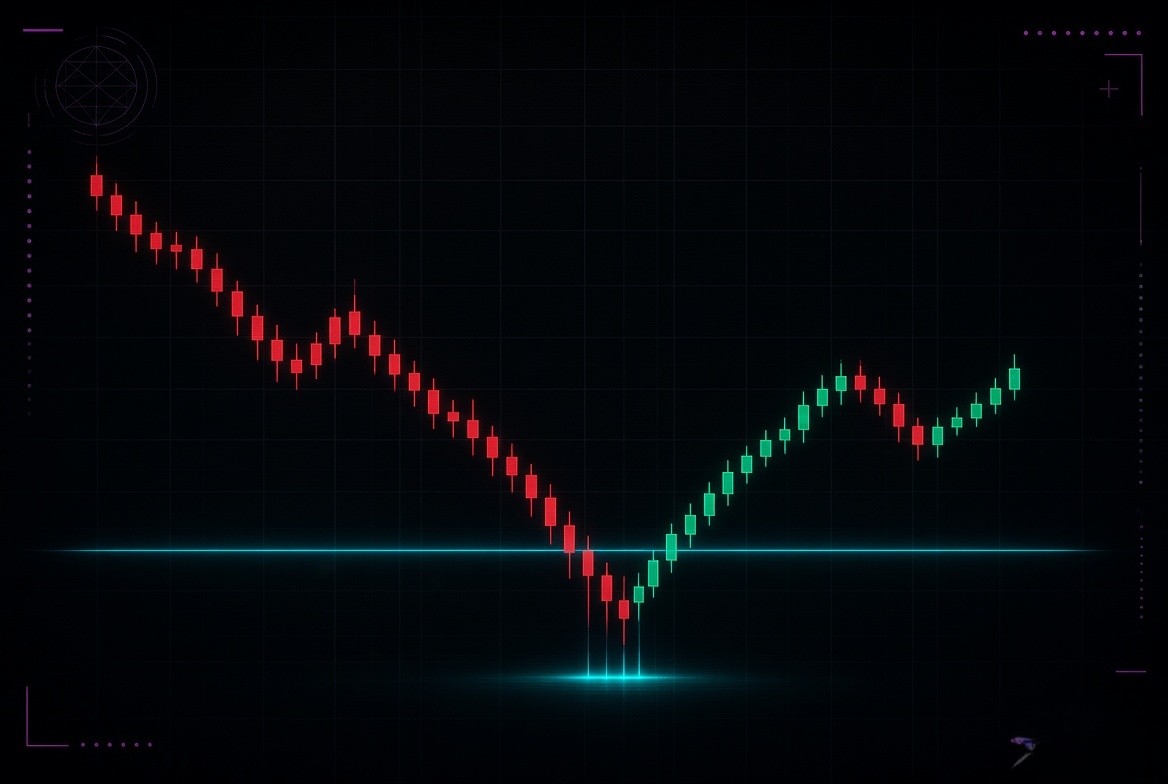
Not because I like watching red on the screen. Because I was ready for it. I'd let enough capital sit parked before the pullback came in a hurry — and being parked, ready, at the exact moment other people are panicking, is the whole game. This is an article about the single hardest skill in trading and investing. Not chart patterns. Not options structures. Patience.
Reading the top before it happens
Before the selloff, something felt off. Prices were pressing at their highs, but the strength behind the moves wasn't there. Each push higher felt like it was running on fumes — lower conviction, less follow-through, the auction struggling to find buyers willing to pay up.
Someone standing outside the market glances at a chart near all-time highs and casually says "that'll pull back." Easy to say when you have no skin in the game. But when you're a player — active every week, every month, whatever your timeframe is — that same instinct becomes something you second-guess constantly, because acting on it costs you if you're wrong. The discipline isn't having the intuition. It's learning to trust it enough to prepare, while being humble enough not to bet the farm on the timing.
So you park capital. You get ready. Because these opportunities do come — usually a few times a year — and the only question is whether you're positioned to use them when they arrive.
The clearance sale
Then the pullback hits. And it genuinely is a clearance sale — the assets you already wanted, marked down.
But a sale only helps you if you decided in advance what you'd pay. This is where most people fall apart. They get excited, they see red, they pile in above the levels they'd promised themselves, chasing the falling knife because it "feels cheap." The discipline is sticking to the lines you drew when you were calm — not entering early, above your plan, in the heat of the moment.
For me, those lines are often a meaningful moving average — a 100-day EMA gives me comfort and structure in the decision, a level I can point to and know I'm executing a plan rather than reacting to a feeling. The specific level matters less than the fact that you set it cold, before the emotion arrived.
The waiting period, as a bottom builds
Then comes the part almost nobody can sit through: the wait while a bottom forms.
It happens in different ways. Sometimes a sharp V-bottom. Sometimes a V first, then repeated tests back down toward your entry level as the asset gets accumulated over time. They all resolve eventually, but they move on their own schedules — and here's the tell worth watching: the names in genuine demand get snapped up fast, which is why they V-bottom. The ones that grind sideways and re-test are being accumulated more patiently, because the urgent demand isn't quite there yet.
If you follow a whole industry or thesis — say the AI names as a group — you start to read the demand across the basket, like watching the individual members of an index rather than the index itself. You see which ones the market wants now and which need time. And the honest truth is: you won't catch them all at the bottom. Some will run before you're fully positioned. Some will crawl. That's fine. The job isn't perfection — it's entering only at the levels you set outside the heat of the moment, and scaling in as a planned execution rather than dumping all your capital in at once. That way you're never wasting your time, but you always retain the ability to buy lower if the market offers it.
Why patience is the actual edge — the data
This isn't just philosophy. The numbers are brutal on the impatient and generous to the disciplined.
On the impatient side: across roughly 30 academic studies spanning 8 countries and 25 years, somewhere between 70% and 97% of day traders lose money depending on the market and how you define the term. One landmark study followed 1,600 Brazilian day traders for over a year and found only 3% turned a profit, and a scant 1.1% earned more than minimum wage. The reason isn't usually strategy — it's psychology. Losing traders place four times more trades than winning traders, driven by revenge trades, chasing, and the need for action.
On the patient side, the reward for simply staying in and waiting is almost absurd. Bank of America, examining nearly a century of data back to 1930, found that an investor who missed the S&P 500's 10 best days each decade earned a total return of 28%, while one who stayed fully invested through every up and down earned 17,715%. Over a more recent 30-year window, missing just the 30 best days dropped the average annual return from 8.4% to 2.1% — below the rate of inflation.
And here's the part that ties directly back to buying the pullback: those best days cluster around the worst ones. In one stretch of March 2020, three of the 30 best days and five of the 30 worst days occurred within eight trading days of each other. The enormous up-days happen right in the teeth of the fear — which means the person who panic-sold the selloff is almost guaranteed to miss the recovery. Being parked and ready isn't caution. It's the only way to be present for the days that actually matter.
Chart reading is the entry ticket — not the whole game
Let me be blunt about something. In this day and age, anyone actively investing or trading with no ability to read a chart is either wasting time or has time to waste.
Technical chart reading is a genuine skill — but it's a learnable one, and it's what lets you set your rules for entering trades on companies you already like fundamentally. A chart is an auction. Once you can see it that way — buyers and sellers fighting over price, strength and weakness revealing themselves in the candles — you have the tool to define exactly where you'll act.
But the chart is only the entry ticket. After that, it's patience, and most people simply don't have it. That's precisely why so many people gravitate to day trading first: it's more action, more emotion, more dopamine. It feels like doing something. But that feeling is the tell — it's closer to gambling than trading, and the data shows those traders don't last. One dataset tracking 360,000 traders over 14 years found only 13% were still trading after three years, and fewer than 7% remained by year five.
Real trading — the kind you can do for a living — is the quiet opposite: patience and discipline, repeated.
Staying ready, steady, and in the game
I get genuinely excited about this recent tech and AI pullback. And I'll be honest that it's hard at times to maintain exposure through the chop so I can capitalize on the upside when it finally comes. But having my initial plan — and modifying it as the market reveals where the real demand is — is what keeps me ready, steady, and in the game.
Here's my own scorecard, and it's simple. When the move eventually runs and I look back to find my entries sitting on the lower wicks of a daily or weekly candle, right at a major moving average — I know I was disciplined. And when my entries are scattered above my lines, bought in a rush? I know I messed up, and I know to relax next time. Because the undisciplined version never makes as much money. Not once. The market pays the patient and taxes the anxious, every single time.
If there's one thing to take from all of this: the opportunity isn't the pullback. Everyone sees the pullback. The opportunity is having decided, calmly and in advance, exactly what you'd do when it came — and then having the patience to actually do it.
This kind of disciplined entry — waiting for price to come to a level you set in advance, then executing without emotion — is exactly what a simulator is built to rehearse. On the Passive Nomads simulator you can replay five years of real market history on names like SPY, Tesla, Nvidia and Rio Tinto, set your levels, and practise the patience before real capital is on the line. Because the plan is easy to write. Sitting on your hands until price hits it is the part that takes reps.