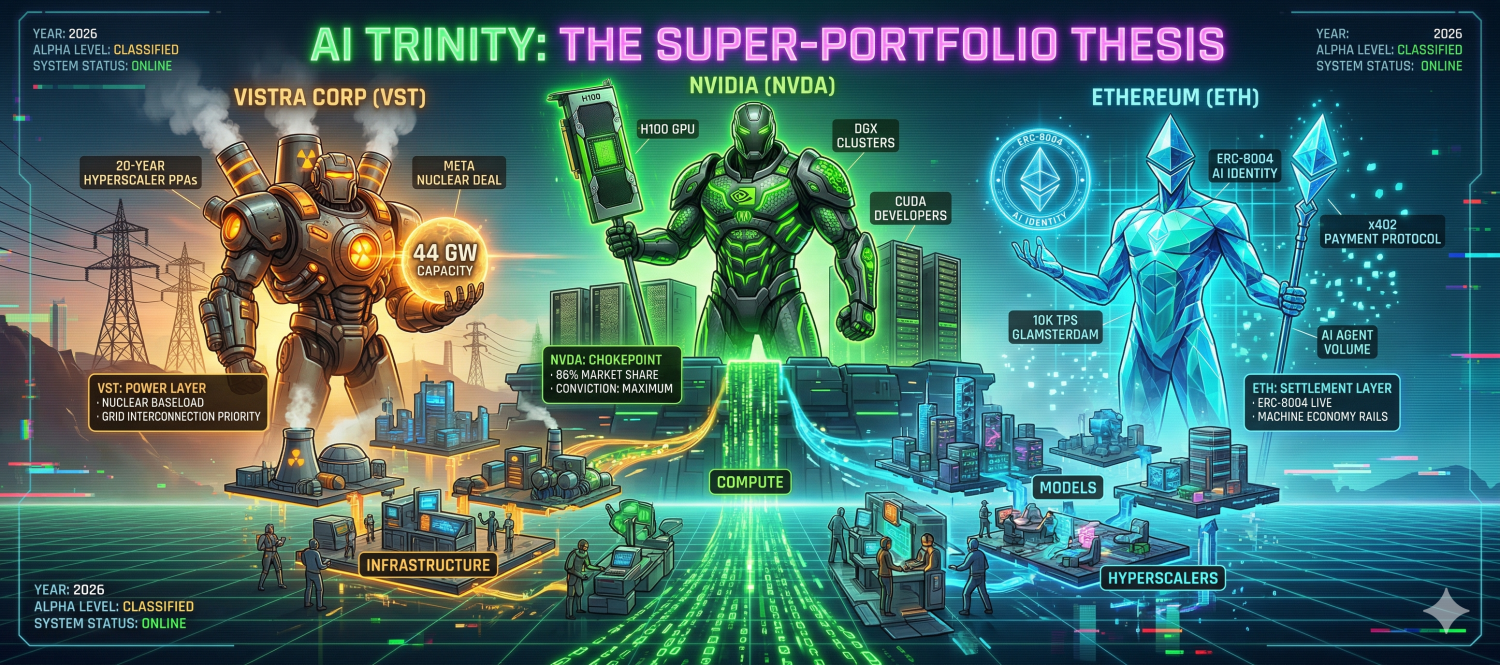
The AI economy requires three foundations: the intelligence to compute, the rails to transact, and the power to run it all. Most investors chasing AI exposure pile into the same layer — software and services — with overlapping risk and correlated drawdowns. This thesis takes a different approach. One position per layer. Every thread of the AI supercycle leads back to these three names.
Node 01 — NVDA: the compute layer
NVDA is the chokepoint of the entire AI stack. 86% AI chip market share. Every LLM trained, every drug discovered, every autonomous system deployed runs on Nvidia silicon. The CUDA ecosystem has over 4 million developers and switching costs that are existential — not inconvenient, existential.
- Order backlog: $500B+
- Forward P/E (FY28): 16.7x — cheaper than most industrial companies
- PEG ratio: <0.7 — undervalued on growth-adjusted basis
- Analyst target: $268 avg · $307 fair value
NVDA builds the intelligence. Every GPU shipped to Amazon, Google, Microsoft, and Meta traces back here. $500B+ in locked orders. The most defensible moat in technology. NVDA is everywhere because it is foundational to everything.
The primary risk is geopolitical — China export controls, US-China tech war, and Taiwan supply chain concentration via TSMC. Hyperscalers are also developing custom silicon internally, which could reduce external GPU demand 15–20% over time. Neither changes the core thesis. Conviction: maximum. Status: core hold.
Node 02 — ETH: the settlement layer
Ethereum is the layer most AI investors completely miss. Here is the structural insight: AI agents cannot open bank accounts. Cannot use credit cards. Ethereum is the only existing infrastructure where software autonomously holds value, establishes identity, and settles transactions without human intermediaries. The machine economy runs here.
- Current price: ~$2,190 — 56% below the $4,954 ATH
- ERC-8004 AI agent identity: live on mainnet
- x402 machine payment protocol: 140M+ transactions processed
- AI agent volume: $9.1B YTD 2026
- Glamsterdam upgrade: ~Jun 2026 · 10,000 TPS target
ETH settles the transactions. This is not speculation — it is infrastructure being built now by Coinbase, Google, Stripe, and Ant Group simultaneously. Fusaka fixed the burn rate. Glamsterdam brings 10,000 TPS. Post-quantum roadmap: active.
Risks worth watching: Glamsterdam upgrade slippage, Solana competing for AI agent volume, ECDSA quantum vulnerability in the 2030–35 window, and the nuanced point that stablecoins — not ETH itself — are the transaction currency. ETH captures the gas fee layer. Conviction: high. Status: thesis build.
Node 03 — VST: the power layer
Vistra is the least obvious position and arguably the most structurally important. Every Nvidia GPU that Amazon, Microsoft and Meta operate needs electrons. Vistra has 44 GW of generation capacity — nuclear, gas, and storage — and 20-year power purchase agreements to supply those electrons to the hyperscalers driving the $600B capex wave.
- Hyperscaler PPAs: Amazon + Microsoft + Meta
- Meta nuclear deal: 2,609 MW · 20-year contract
- Analyst target: $230 avg · ~29% upside
- Forward P/E: 15.5x
VST powers it all. While the rest of the energy sector waits in a grid interconnection queue that stretches five to twelve years, Vistra is already signed, contracted, and delivering. The $80B in idle Azure GPUs exist because of the energy gap. Vistra is the solution.
Primary risks: PJM policy disruption from the Trump emergency auction proposal, elevated debt from the Cogentrix acquisition, and nuclear plant operational concentration at Susquehanna and Perry. Manageable, not thesis-breaking. Conviction: high. Status: accumulate.
The system architecture — why three layers, not three tech stocks
The three positions are symbiotic, not independent. NVDA chips run in data centres powered by VST nuclear plants. AI agents built on NVDA infrastructure settle payments on ETH rails. VST's hyperscaler contracts exist because NVDA GPUs need clean baseload power. Every thread connects.
Zero overlap principle: A US-China tech escalation hurts NVDA but has no bearing on Ethereum's AI agent volume or Vistra's nuclear PPAs. An Ethereum upgrade delay is irrelevant to Nvidia's chip backlog. A regulatory energy event in PJM has nothing to do with CUDA ecosystem lock-in. The three risks are genuinely uncorrelated.
Three layers. Zero overlap. Each captures a different mechanism of the same wave. Together they form a complete, non-redundant expression of the AI economy — from the chip that processes intelligence, to the blockchain that enables autonomous commerce, to the reactor that keeps it all running.
If you believe the AI economy is real and durable — and the $600 billion hyperscaler capex wave suggests the largest companies in the world do — then these three positions give you the most complete, non-overlapping expression of that belief available in public markets today.
Research analysis only. Not financial advice. Always conduct independent due diligence. Past performance does not guarantee future results. Date: 2026.04.13